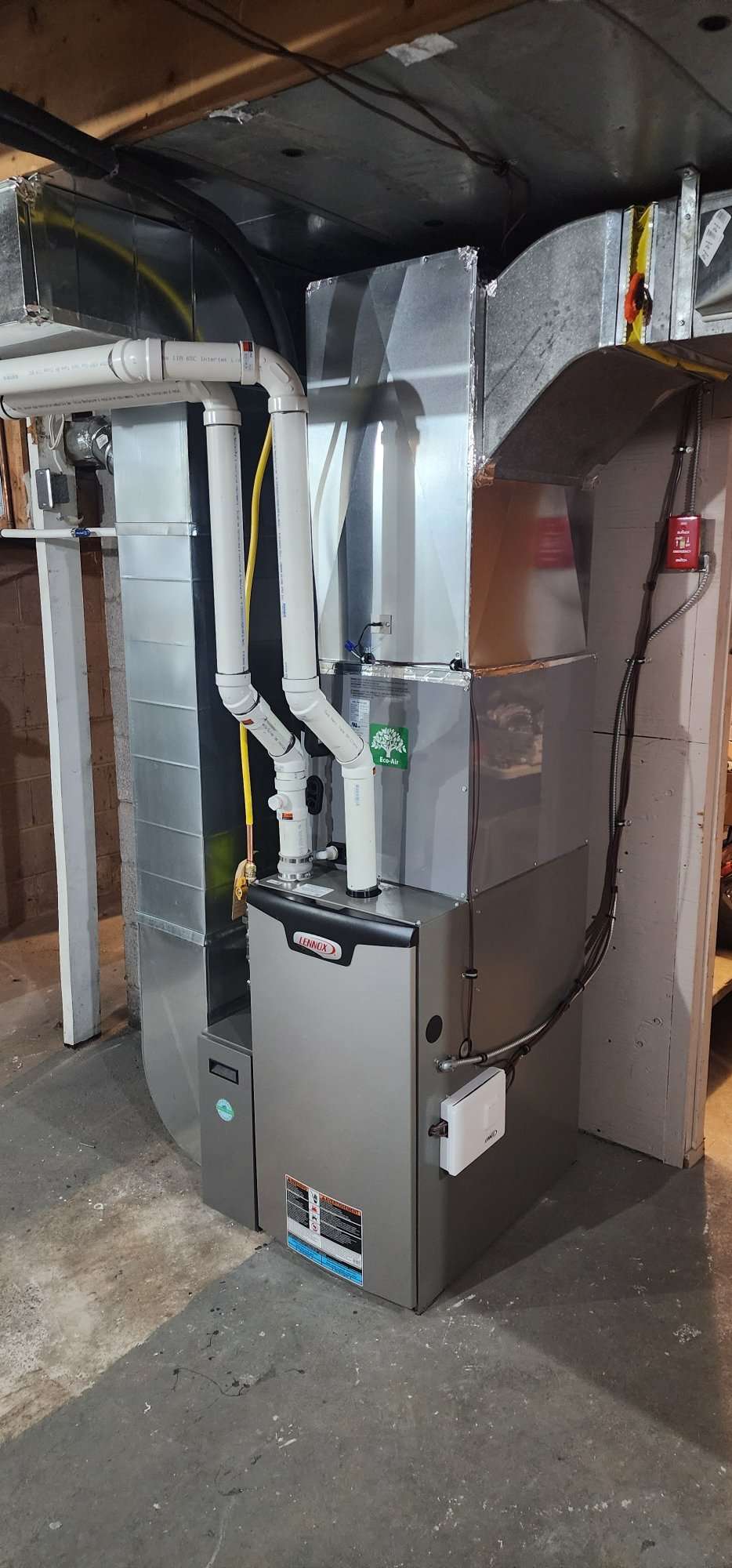
What Size Furnace Do I Need? Why the Square-Footage Rule Gets Ontario Homes Wrong
Written by the Northland Home Comfort team — TSSA-registered heating, cooling and hydronics contractor (FS-R-50021) serving Simcoe County and Muskoka. Updated October 2026.
Short answer: Furnace size is set by a heat-loss calculation, not square footage. In Ontario, a tight newer 2,000 sq ft home may need only 45,000 to 60,000 BTU of output, while an older, drafty home the same size can need 80,000 to 100,000. The common “40 to 50 BTU per square foot” rule oversizes most homes built after 1990, and an oversized furnace short-cycles, runs noisier and wears out sooner. Ontario’s building code requires a CSA F280 heat-loss calculation for new homes; we run the same calculation on replacements.
What a heat-loss calculation looks at
- Design temperature. The coldest temperature the furnace is sized for: about -24°C for Barrie and Orillia, -26°C to -27°C for Gravenhurst and Bracebridge.
- Insulation levels in walls, attic and basement, and whether the basement is finished.
- Windows and doors: area, orientation and glazing type. Big lake-facing glass is a major heat loss.
- Air leakage. The biggest variable in older homes. A blower-door number is best; otherwise we estimate from age and construction.
- Ceiling height and volume. Cathedral ceilings and open stairwells add load.
- Ductwork location. Ducts in an unheated crawlspace or attic lose heat before it reaches the room.
The result is a heat loss in BTU per hour at the design temperature. The furnace output (not input) should cover it with a small margin, usually 10 to 25 percent.
Typical furnace sizes for Ontario homes
| Home | Heat loss at design temp | Furnace (output) |
|---|---|---|
| 1,200 sq ft bungalow, 1970s, original windows | 55,000 – 70,000 BTU/h | 60,000 – 80,000 BTU |
| 1,800 sq ft two-storey, 1990s | 45,000 – 60,000 BTU/h | 60,000 BTU |
| 2,500 sq ft, built 2015+ to current code | 40,000 – 55,000 BTU/h | 60,000 BTU |
| 3,500 sq ft custom home, lots of glass | 70,000 – 100,000 BTU/h | 80,000 – 100,000 BTU |
| 900 sq ft cottage, four-season | 30,000 – 45,000 BTU/h | 40,000 – 60,000 BTU |
Notice how little the size tracks square footage. Also note that furnace nameplates list input; a 60,000 BTU input furnace at 96 percent efficiency delivers about 57,600 BTU of output.
Why oversizing is a problem
- Short cycling. The furnace heats the house in a few minutes, shuts off, and repeats. More starts, more wear, more temperature swing. See furnace short cycling.
- Noise and drafts. A big blower moving a lot of air through ducts that were sized for less.
- Poor humidity control and uneven rooms. The rooms near the furnace get warm fast and the far rooms never catch up before it shuts off.
- Lower real-world efficiency. Furnaces are most efficient in long, steady cycles.
- It costs more. Bigger furnace, bigger price, for a worse result.
Why undersizing is rare but real
A furnace that cannot keep up on the coldest night is a real problem, which is why installers oversize “to be safe.” The fix is a proper calculation with a modest margin, not a 40 percent safety factor. In hybrid heat pump systems, the furnace only has to cover the deep cold, and a two-stage furnace gives you both.
Ductwork sets the limit
A furnace can only deliver what the ducts can carry. We measure static pressure and look at the returns and trunk sizes on the site visit. If the ducts are undersized, the honest options are to fix the ducts or choose a furnace with a variable-speed blower that can work within them — not to install a bigger furnace.
What to ask an installer
Ask what size they are proposing and how they got the number. “We always put in 80s” is not a calculation. A good quote names the model, the input and output BTU, the stages, and the heat-loss result it was sized against. See what a furnace costs in Ontario and what a quote should include.
Frequently asked questions
Anywhere from 45,000 to 90,000 BTU depending on age, insulation, windows and air leakage. A newer code-built home is at the low end; a 1970s home with original windows is at the high end. Only a heat-loss calculation can tell you which.
No. An oversized furnace short-cycles, runs louder, leaves far rooms cold and wears out sooner. Size it to the calculated heat loss with a small margin.
It is the Canadian standard for calculating residential heat loss and heat gain, referenced by the Ontario Building Code for new homes. It accounts for insulation, windows, air leakage and the local design temperature.
It helps, because it runs on low fire most of the time, but it does not fix a furnace that is far too big. Size correctly first, then choose staging.
Not reliably. Old furnaces were often oversized, and the house may have had insulation or windows replaced since. We recalculate every time.
We run the heat loss on every replacement before we quote a size. Book a free in-home assessment.